Gua sha for face and body: a functional medicine take on lymph, fascia and the daily ritual
Why this 2,000-year-old practice earns its place in a modern routine — how to prep, which tool to choose, and how it compares to dry body brushing for lymphatic flow.
Written by Amy Morris, BSc (Hons) Nutritional Therapy — Functional Nutritional Therapist
Gua sha has been quietly used in East Asian medicine for over two thousand years, long before it became a Saturday-morning wellness ritual on Instagram. From a functional medicine lens, what makes it interesting isn't the glow — it's what it does for the tissue underneath: fascia, microcirculation, and the lymphatic system that quietly clears the body's waste.
What gua sha actually does to the tissue
Gua sha — literally 'to scrape sand' — uses a smooth-edged tool drawn across lubricated skin in slow, repeated strokes. On the body, traditional practitioners use enough pressure to draw 'sha', the temporary red petechiae that signals stagnant blood being released into the surface tissue for clearance. On the face, the work is far gentler — barely the weight of the tool — and the goal is lymphatic drainage, fascial release and microcirculation rather than visible marking.
A small but growing body of research supports the mechanism. A 2011 study in Pain Medicine using laser Doppler imaging showed gua sha produced a fourfold increase in microcirculation at the treated area, lasting up to 25 minutes after a single session (Nielsen et al., 2007/2011). That improved perfusion is the same mechanism that supports lymphatic uptake — lymph relies on movement, pressure changes and adjacent blood flow to drain.
The lymphatic case — what the evidence does and doesn't say
The lymphatic system has no pump of its own. It moves through muscle contraction, breath, and external pressure on the skin. Anything that rhythmically compresses superficial tissue — walking, rebounding, manual lymphatic drainage, dry brushing, gua sha — can in theory support flow.
The strongest direct evidence sits with manual lymphatic drainage (MLD), the medical technique gua sha most resembles in its facial application. A 2015 Cochrane review and subsequent trials show MLD reliably reduces lymphoedema and post-surgical swelling. Gua sha hasn't been studied to the same depth, but the mechanical principle is shared: slow, directional strokes toward lymph node clusters (under the jaw, behind the collarbone, in the armpit and groin) encourage fluid to move where it can be filtered.
- Improved local microcirculation (Nielsen, Pain Medicine, 2007) — strong evidence.
- Reduced myofascial pain and stiffness (multiple RCTs in neck and back pain) — moderate evidence.
- Anti-inflammatory effect via heme oxygenase-1 upregulation in animal models — mechanistic, plausible.
- Direct lymphatic clearance — biologically plausible, extrapolated from MLD data, not yet proven head-to-head.
The honest read: gua sha almost certainly helps lymph move. We just don't yet have the trials to quantify how much, compared to other modalities.
How to prep — the part most people skip
Gua sha on dry skin is how you get irritation, broken capillaries and zero benefit. Preparation is half the practice.
- Cleanse first. You don't want to drag the day's pollution and SPF deeper into the tissue.
- Apply a generous layer of facial oil — enough that the tool truly glides, never drags. Squalane, jojoba and rosehip are well-tolerated; avoid essential-oil-heavy blends if your skin is reactive.
- On the body, use a richer oil (sweet almond, sesame, or a body-specific blend) and warm it between your palms first.
- Start with the neck, always. Open the drainage pathway before you push fluid toward it — three to five slow strokes down the side of the neck toward the collarbone, both sides.
- Work cool, not cold. A chilled stone feels lovely on a puffy morning face, but ice-cold tools can constrict the very vessels you're trying to encourage.
- Hydrate before and after. Lymph is mostly water. Moving it without replacing it is a waste of the ritual.
The tools — and how to choose
There are broadly four families of gua sha tool, and they are not interchangeable. The material matters less than the shape, the weight, and where you intend to use it.
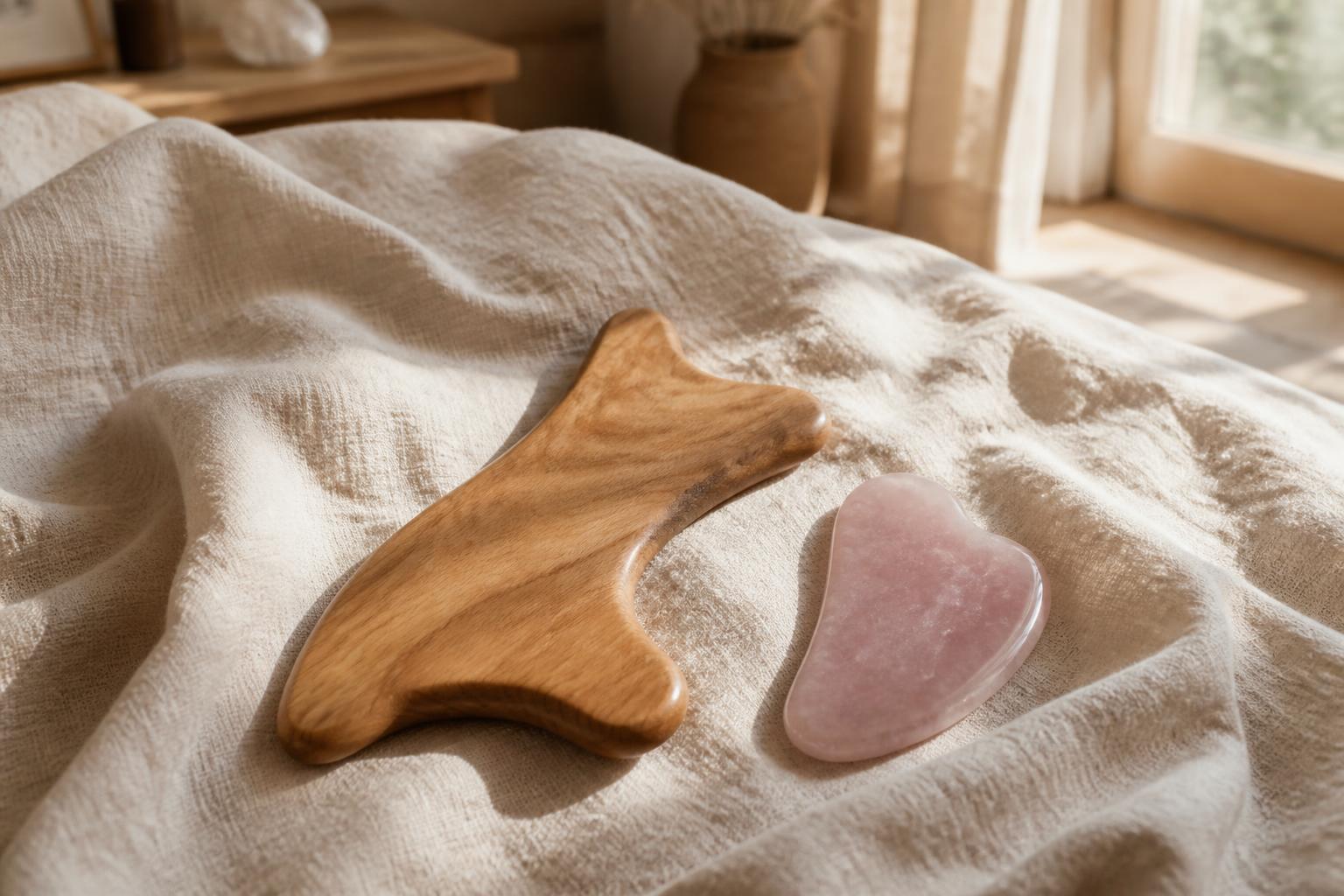
- Rose quartz — the classic facial tool. Naturally cool, gentle, slightly porous. Excellent for sensitive or reactive skin. Will warm to skin temperature within a minute.
- Jade (nephrite or jadeite) — denser than quartz, holds temperature longer. Traditional, durable, slightly more 'grippy' on oiled skin which some people prefer for control.
- Bian stone — a dark, mineral-rich slate used in traditional Chinese practice. Said to release trace minerals and infrared warmth. Heavier feel; good for stronger facial work and the décolletage.
- Wood (beech, sandalwood, or boxwood) — the body tool. Larger, contoured for thighs, glutes, arms and back. Wood is warm, light, and doesn't shatter if dropped in the shower. Often shaped with concave curves to wrap around the leg or arm.
- Stainless steel — clinical, hygienic, easy to sanitise. Common in IASTM (instrument-assisted soft tissue mobilisation) and physio settings rather than the morning bathroom shelf.
One face tool, one body tool. The shapes are different for a reason — a small facial heart will not give you useful pressure across a thigh, and a body scraper is far too large to navigate around the eye.
Face vs body — two different practices
Facial gua sha is light, slow, and lymph-led. Three to five passes per stroke, always moving outward and downward toward the drainage points at the jaw, ear and collarbone. Five minutes is plenty. If you're seeing redness, you're pressing too hard.
Body gua sha is firmer and more fascial. Long strokes up the calves, the back of the thighs, the outer hip and the arms — always toward the heart, always toward the nearest lymph node cluster. You can press meaningfully here; mild pinkness afterwards is normal and clears within minutes. Avoid varicose veins, broken skin, recent surgical sites, and the front of the throat.
Gua sha vs dry body brushing
Both target the same system. They do it differently, and they're more useful together than as substitutes.
- Dry brushing is exfoliating and stimulating — bristles activate sensory nerves and gently shift superficial lymph. It's fast (two minutes), done before showering, and best in the morning.
- Body gua sha is slower, deeper, and works the fascia as well as the lymph. It uses oil, takes 10–15 minutes, and is better suited to the evening or a weekend slot.
- Brushing is broader and more superficial; gua sha is more targeted and goes through fascia. Think of brushing as priming the surface, and gua sha as the deeper drainage session.
- Skin tolerance matters: dry brushing can be too harsh for eczema-prone or very dry skin, where gua sha with oil is far gentler.
A reasonable weekly rhythm: dry brush most mornings before the shower; body gua sha two or three evenings a week after a warm bath.
The functional medicine frame
From a functional perspective, gua sha sits inside the broader work of drainage and detoxification — alongside hydration, daily bowel movements, sweat, sleep, and stress regulation. It is not a treatment for any disease. It is a low-cost, low-risk way to support the body's natural clearance pathways and, just as importantly, to spend five minutes a day with your own nervous system in parasympathetic mode.
That last piece may be the most underrated benefit. The slow, repetitive, tactile rhythm of gua sha down-regulates the stress response in a measurable way — heart rate variability tends to rise, breathing slows, the face softens. In a culture that under-touches itself, a daily ritual of intentional, gentle pressure is its own form of medicine.
References
- Nielsen A et al. The effect of Gua Sha treatment on the microcirculation of surface tissue: a pilot study in healthy subjects. Explore (NY) 2007;3(5):456–466.
- Nielsen A. Gua sha research and the language of integrative medicine. J Bodyw Mov Ther 2011;15(1):63–66.
- Nielsen A et al. Gua sha for chronic low back pain. Pain Med 2007;8(8):362–370.
- Braun M et al. Effectiveness of traditional Chinese 'gua sha' therapy in patients with chronic neck pain: a randomized controlled trial. Pain Med 2011;12(3):362–369.
- Mortimer PS, Rockson SG. New developments in clinical aspects of lymphatic disease. J Clin Invest 2014;124(3):915–921.
The takeaway
Choose two tools — one for the face, one for the body. Prep the skin properly, work toward the lymph nodes, and pair it with dry brushing rather than choosing between them. The lymphatic and nervous-system benefits compound the more boringly consistent you are.
Monthly newsletter
Liked this? Get the monthly note.
One email a month with new research made readable, plus practical nutrition and habit notes from the Kitchen Table.