The best supplements for sleep: magnesium glycinate, glycine, taurine and what the research actually says
A functional medicine guide to the most evidence-backed supplements for better sleep — magnesium glycinate, glycine, taurine, L-theanine, apigenin, ashwagandha and more — plus why none of them work properly until your sleep hygiene and circadian habits are in place.
Written by Amy Morris, BSc (Hons) Nutritional Therapy — Functional Nutritional Therapist
Supplements are the most-Googled solution to bad sleep — and the most over-promised. The truth is more useful: a handful of well-researched nutrients can genuinely shift sleep latency, depth and morning energy, but only once your nervous system, light exposure and evening routine give them something to work with. This is a clear, referenced walk-through of what actually has data behind it (magnesium glycinate, glycine, taurine, L-theanine, apigenin, ashwagandha, melatonin and a few honourable mentions), how to use them sensibly, and the sleep-hygiene foundations to build first.
Start here: supplements are the last 10%, not the first
Sleep is a behaviour before it is a biochemistry problem. Circadian rhythm is set by light, movement, meal timing, temperature and the wind-down rituals you give your nervous system — and no capsule can out-supplement a bright phone in a hot bedroom at midnight (Walker, Why We Sleep, 2017; Wright et al., Curr Biol 2013).
Functional medicine practitioners almost always work in this order: optimise sleep hygiene → support the circadian system with light and meal timing → address obvious physiological drivers (caffeine, alcohol, blood sugar, perimenopause, iron, thyroid) → then, and only then, layer in targeted supplements. Skipping straight to step four is why people end up with a drawer full of bottles and still can't fall asleep.
The non-negotiable sleep hygiene checklist
Before any supplement is worth trialling, give yourself two to four weeks of these basics. They sound boring because they are — and because they work.
- Get 10–20 minutes of outdoor daylight within 30–60 minutes of waking. Morning light anchors melatonin onset roughly 14 hours later (Blume et al., Somnologie 2019).
- Keep a consistent wake time, including weekends. Wake time is a stronger circadian anchor than bedtime (Phillips et al., Sci Rep 2017).
- Stop caffeine by noon. Caffeine has a half-life of 5–7 hours and measurably reduces deep sleep even when you fall asleep fine (Drake et al., J Clin Sleep Med 2013).
- Cap alcohol — even one drink fragments REM and raises overnight heart rate (Pietilä et al., JMIR Mental Health 2018).
- Eat your last substantial meal 2–3 hours before bed; a small protein-and-carb snack is fine if you wake at 3am hungry.
- Cool, dark, quiet bedroom — aim for 16–19°C, blackout curtains, no LEDs (Okamoto-Mizuno & Mizuno, J Physiol Anthropol 2012).
- Dim overhead lights and get off bright screens 60–90 minutes before bed; even moderate evening light suppresses melatonin (Gooley et al., J Clin Endocrinol Metab 2011).
- A predictable wind-down: shower, stretch, read, journal, breathwork. Cue the nervous system that the day is closed.
If you haven't done two solid weeks of sleep hygiene, you don't actually know whether you need a supplement — you might just need a cooler room and morning light.
Rule out the physiological hijackers first
Persistent insomnia is rarely random. Before reaching for sleep stacks, it's worth asking a clinician to consider perimenopause and progesterone decline (a huge driver of 3am wake-ups in women over 35), low ferritin and iron deficiency (linked to restless legs and fragmented sleep), thyroid dysfunction, untreated sleep apnoea, blood sugar dysregulation, and chronic stress with a flattened cortisol curve (Baker & Lee, Sleep Med Clin 2018; Allen et al., Sleep Med 2018).
A supplement can mask the symptom of one of these and delay the actual fix. This is one of the main reasons I push blood tests early — magnesium glycinate is a much better adjunct to treating low ferritin than it is a substitute.
Magnesium glycinate — the calm-down mineral
Magnesium is involved in over 300 enzymatic reactions, including GABA receptor activity, melatonin synthesis and parasympathetic tone (de Baaij et al., Physiol Rev 2015). It's also the mineral most reliably depleted by modern soil, chronic stress, alcohol, coffee and many medications (DiNicolantonio et al., Open Heart 2018).
For sleep, magnesium glycinate is the form to know. Glycinate is magnesium bound to the amino acid glycine — which, conveniently, is itself a sleep-supportive neurotransmitter (see below). It's gentle on the gut, well absorbed, and doesn't have the laxative effect of magnesium citrate or oxide.
A 2012 randomised trial in older adults with insomnia found that 500 mg of elemental magnesium daily improved sleep efficiency, sleep onset, serum melatonin and cortisol versus placebo (Abbasi et al., J Res Med Sci 2012). A 2021 systematic review concluded the evidence is most consistent for subjective sleep quality and falling asleep faster (Mah & Pitre, BMC Complement Med Ther 2021).
Typical dose: 200–400 mg of elemental magnesium (glycinate) 30–60 minutes before bed. Magnesium threonate is the cognitive-leaning cousin and crosses the blood-brain barrier well; many people use a small dose of threonate alongside glycinate.
Glycine — the temperature-drop trick
Glycine is an inhibitory neurotransmitter and one of the most underrated sleep aids. It works partly by promoting peripheral vasodilation — which drops core body temperature, a key physiological trigger for sleep onset (Kawai et al., Neuropsychopharmacology 2015).
Japanese trials using 3 g of glycine 30–60 minutes before bed have shown improved subjective sleep quality, faster sleep onset, less next-day fatigue and better cognitive performance after partial sleep restriction (Yamadera et al., Sleep Biol Rhythms 2007; Bannai et al., Front Neurol 2012).
It is genuinely well tolerated, cheap, and tastes mildly sweet, so it's easy to mix into water. Useful alone or combined with magnesium glycinate (which is already supplying some glycine).
Taurine — the GABA enhancer
Taurine is an amino acid that acts as an agonist at GABA-A receptors, the same family of receptors that benzodiazepines target — but without the dependency profile (Jia et al., J Neurosci 2008). It supports parasympathetic tone, modulates cortisol, and has cardiovascular and blood-sugar benefits as a bonus.
Human sleep trials specifically on taurine are still limited, but mechanistic and animal data are strong, and clinically it shines for people whose sleep problem is racing thoughts, evening anxiety, or palpitations. Typical dose: 500–2000 mg in the evening. Pairs well with magnesium glycinate.
L-theanine — green-tea calm without sedation
L-theanine is an amino acid from green tea that increases alpha brain waves (the relaxed-but-alert state) and modulates GABA, dopamine and serotonin (Nobre et al., Asia Pac J Clin Nutr 2008). A 2019 randomised trial found 200 mg daily for four weeks improved sleep quality, mental health and cognition in stressed adults (Hidese et al., Nutrients 2019).
It doesn't knock you out — it takes the edge off the wired-and-tired state. Excellent for people who lie down already-buzzing. Typical dose: 200–400 mg, 30–60 minutes before bed; safe to combine with magnesium glycinate and glycine.
Apigenin — the chamomile compound
Apigenin is a flavonoid concentrated in chamomile, parsley and celery, and the active ingredient behind chamomile tea's calming reputation. It binds benzodiazepine sites on GABA-A receptors and has mild anxiolytic and sleep-promoting effects (Salehi et al., Molecules 2019). A small randomised trial of chamomile extract in older adults with insomnia improved sleep quality scores significantly (Adib-Hajbaghery & Mousavi, Complement Ther Med 2017).
Popularised more recently by Andrew Huberman, isolated apigenin (50 mg) is now a common addition to evening stacks. Worth a trial, especially for women — note it has mild oestrogen-modulating effects, so go gently if you have oestrogen-sensitive conditions and check with a practitioner.
Ashwagandha — for the cortisol-driven 3am wake-up
Ashwagandha (Withania somnifera — the species name literally means 'sleep-inducing') is an adaptogen with the strongest evidence base of any herb in this category. A 2021 systematic review and meta-analysis of five randomised trials concluded ashwagandha had a small-to-moderate but significant improvement on sleep quality, sleep onset latency and anxiety, particularly in people with insomnia (Cheah et al., PLoS One 2021).
It works upstream — lowering perceived stress and cortisol rather than sedating directly (Salve et al., Cureus 2019). Best for the person who lies in bed mentally rehearsing tomorrow, or who wakes at 3am wide-eyed with a racing heart. Typical dose: 300–600 mg of a standardised extract (KSM-66 or Sensoril) once or twice daily for 6–8 weeks before judging.
Melatonin — small dose, right timing, not a sleeping pill
Melatonin is widely misunderstood. It's not a sedative — it's a circadian signal that tells the body 'it's biological night'. Most over-the-counter doses (3–10 mg) are 10–30 times the physiological dose and can leave people groggy, vivid-dreaming, or paradoxically more wired (Vasey et al., Nutrients 2021).
The most useful applications are short-term: jet lag, shift work, delayed sleep phase, and supporting older adults whose endogenous melatonin has declined. Effective doses are typically 0.3–1 mg, taken 30–60 minutes before desired sleep onset (Auld et al., Sleep Med Rev 2017). For chronic insomnia in healthy adults, melatonin is not the first tool I reach for; magnesium, glycine and behaviour usually do more.
Honourable mentions worth knowing about
- Lemon balm (Melissa officinalis): mild GABAergic herb, often paired with valerian; small trials show improved sleep and anxiety (Cases et al., Mediterr J Nutr Metab 2011).
- Valerian root: long history of use; evidence is mixed but consistent for falling asleep faster in chronic users (Bent et al., Am J Med 2006). Smells strong — capsules preferred.
- Passionflower: small randomised trial showed improved sleep quality with passionflower tea (Ngan & Conduit, Phytother Res 2011).
- Tart cherry juice: a natural source of melatonin and tryptophan; small trials show improved sleep duration and quality (Howatson et al., Eur J Nutr 2012).
- Saffron (Affron extract): emerging evidence for mood and sleep at 28 mg daily (Lopresti et al., J Clin Sleep Med 2020).
- 5-HTP and tryptophan: can support serotonin/melatonin pathways but interact with antidepressants — only with practitioner oversight.
- Inositol: useful at higher doses (2–4 g) for women with PCOS-related sleep disruption and anxiety.
A sensible starting stack (and how to trial it)
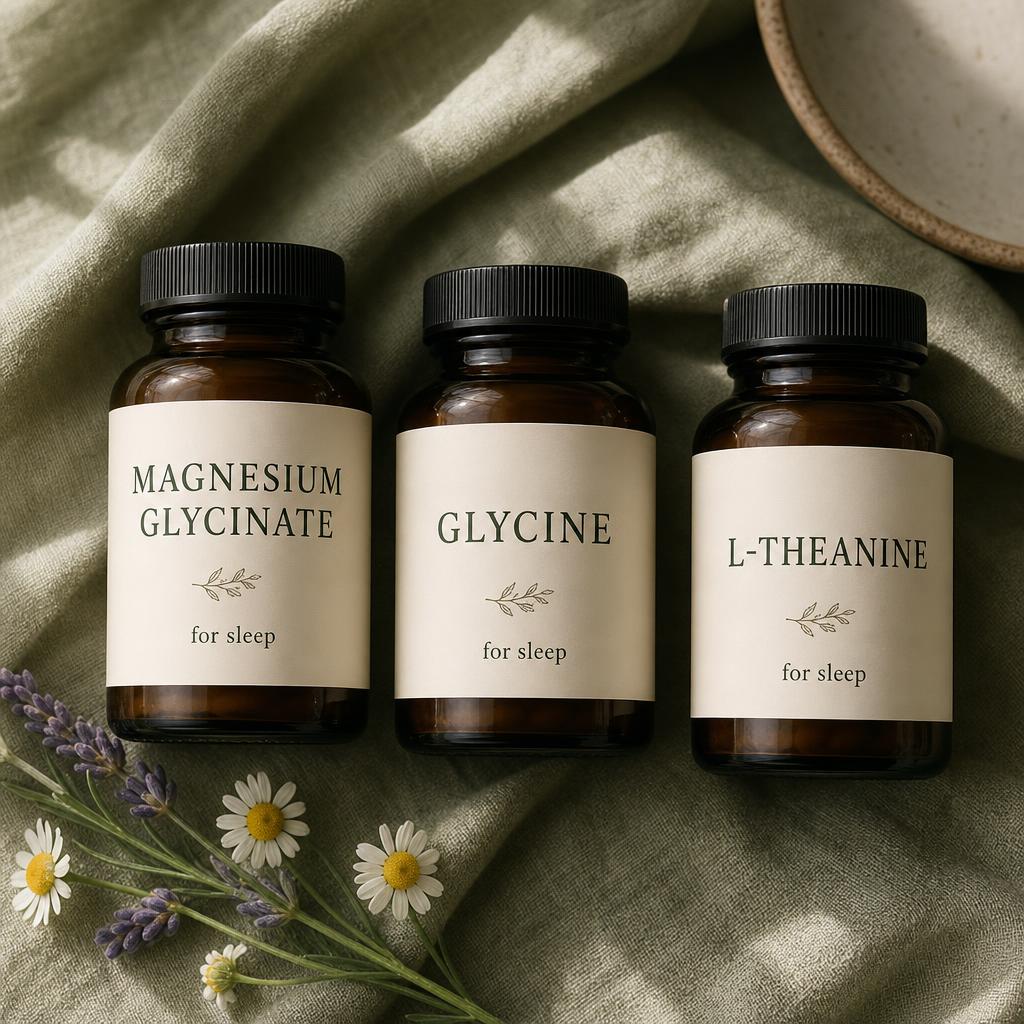
If sleep hygiene is in place and you want to trial something, I'd usually start with one or two products — not seven. A reasonable starting point for most adults is magnesium glycinate (200–400 mg elemental) plus glycine (3 g) about 45 minutes before bed for two weeks. If anxiety or a racing mind is the dominant feature, add L-theanine 200 mg or taurine 1 g. If you suspect cortisol-driven 3am wake-ups, add ashwagandha (300 mg KSM-66) in the morning and evening for 6–8 weeks.
Change one variable at a time, give it at least 14 nights, and track simple metrics: time to fall asleep, number of wake-ups, how you feel at 9am. If nothing has shifted after a fair trial, the answer isn't 'more supplements' — it's revisiting the foundations or looking deeper at hormones, iron, thyroid, blood sugar or sleep apnoea.
Two supplements, taken consistently for two weeks, will teach you more than seven supplements taken inconsistently for two months.
Safety notes — please read
Supplements are not benign. Always check interactions if you take prescription medication — especially antidepressants, benzodiazepines, blood pressure medication, thyroid medication or anticoagulants. Pregnant and breastfeeding women should clear anything beyond a prenatal with a qualified practitioner. Ashwagandha is contraindicated in pregnancy and with some thyroid conditions. Melatonin is not recommended for under-18s without specialist guidance. If you have a complex health picture, work with a nutritional therapist or functional medicine clinician rather than self-prescribing from social media.
References
- Abbasi B, Kimiagar M, Sadeghniiat K, et al. The effect of magnesium supplementation on primary insomnia in elderly. J Res Med Sci 2012;17(12):1161–1169.
- Adib-Hajbaghery M, Mousavi SN. The effects of chamomile extract on sleep quality among elderly people. Complement Ther Med 2017;35:109–114.
- Allen RP, Picchietti DL, Auerbach M, et al. Evidence-based and consensus clinical practice guidelines for the iron treatment of restless legs syndrome. Sleep Med 2018;41:27–44.
- Auld F, Maschauer EL, Morrison I, et al. Evidence for the efficacy of melatonin in the treatment of primary adult sleep disorders. Sleep Med Rev 2017;34:10–22.
- Baker FC, Lee KA. Menstrual cycle effects on sleep. Sleep Med Clin 2018;13(3):283–294.
- Bannai M, Kawai N, Ono K, et al. The effects of glycine on subjective daytime performance in partially sleep-restricted healthy volunteers. Front Neurol 2012;3:61.
- Blume C, Garbazza C, Spitschan M. Effects of light on human circadian rhythms, sleep and mood. Somnologie 2019;23(3):147–156.
- Cases J, Ibarra A, Feuillère N, et al. Pilot trial of Melissa officinalis L. extract in volunteers with mild-to-moderate anxiety and sleep disturbances. Mediterr J Nutr Metab 2011;4(3):211–218.
- Cheah KL, Norhayati MN, Husniati Yaacob L, et al. Effect of Ashwagandha (Withania somnifera) extract on sleep: a systematic review and meta-analysis. PLoS One 2021;16(9):e0257843.
- de Baaij JHF, Hoenderop JGJ, Bindels RJM. Magnesium in man: implications for health and disease. Physiol Rev 2015;95(1):1–46.
- DiNicolantonio JJ, O'Keefe JH, Wilson W. Subclinical magnesium deficiency: a principal driver of cardiovascular disease and a public health crisis. Open Heart 2018;5(1):e000668.
- Drake C, Roehrs T, Shambroom J, Roth T. Caffeine effects on sleep taken 0, 3, or 6 hours before going to bed. J Clin Sleep Med 2013;9(11):1195–1200.
- Gooley JJ, Chamberlain K, Smith KA, et al. Exposure to room light before bedtime suppresses melatonin onset. J Clin Endocrinol Metab 2011;96(3):E463–E472.
- Hidese S, Ogawa S, Ota M, et al. Effects of L-theanine administration on stress-related symptoms and cognitive functions in healthy adults. Nutrients 2019;11(10):2362.
- Howatson G, Bell PG, Tallent J, et al. Effect of tart cherry juice on melatonin levels and enhanced sleep quality. Eur J Nutr 2012;51(8):909–916.
- Jia F, Yue M, Chandra D, et al. Taurine is a potent activator of extrasynaptic GABA(A) receptors. J Neurosci 2008;28(1):106–115.
- Kawai N, Sakai N, Okuro M, et al. The sleep-promoting and hypothermic effects of glycine are mediated by NMDA receptors in the suprachiasmatic nucleus. Neuropsychopharmacology 2015;40(6):1405–1416.
- Lopresti AL, Smith SJ, Drummond PD. Effects of saffron on sleep quality in healthy adults with self-reported poor sleep. J Clin Sleep Med 2020;16(6):937–947.
- Mah J, Pitre T. Oral magnesium supplementation for insomnia in older adults: a systematic review and meta-analysis. BMC Complement Med Ther 2021;21(1):125.
- Nobre AC, Rao A, Owen GN. L-theanine, a natural constituent in tea, and its effect on mental state. Asia Pac J Clin Nutr 2008;17(S1):167–168.
- Okamoto-Mizuno K, Mizuno K. Effects of thermal environment on sleep and circadian rhythm. J Physiol Anthropol 2012;31(1):14.
- Phillips AJK, Clerx WM, O'Brien CS, et al. Irregular sleep/wake patterns are associated with poorer academic performance. Sci Rep 2017;7(1):3216.
- Pietilä J, Helander E, Korhonen I, et al. Acute effect of alcohol intake on cardiovascular autonomic regulation during the first hours of sleep. JMIR Ment Health 2018;5(1):e23.
- Salehi B, Venditti A, Sharifi-Rad M, et al. The therapeutic potential of apigenin. Molecules 2019;24(8):1305.
- Salve J, Pate S, Debnath K, Langade D. Adaptogenic and anxiolytic effects of ashwagandha root extract. Cureus 2019;11(12):e6466.
- Vasey C, McBride J, Penta K. Circadian rhythm dysregulation and restoration: the role of melatonin. Nutrients 2021;13(10):3480.
- Wright KP, McHill AW, Birks BR, et al. Entrainment of the human circadian clock to the natural light-dark cycle. Curr Biol 2013;23(16):1554–1558.
- Yamadera W, Inagawa K, Chiba S, et al. Glycine ingestion improves subjective sleep quality in human volunteers. Sleep Biol Rhythms 2007;5(2):126–131.
The takeaway
Build the foundations first — daylight, consistent wake time, caffeine cut-off, cool dark room, wind-down ritual. Then layer in the supplements with the most evidence: magnesium glycinate, glycine and L-theanine for almost everyone; taurine or apigenin for racing minds; ashwagandha for cortisol-driven 3am wake-ups; melatonin only for circadian problems. Change one thing at a time, give it two weeks, and if sleep still isn't shifting, look for the physiological driver underneath — that's where the real answer usually lives.
Monthly newsletter
Liked this? Get the monthly note.
One email a month with new research made readable, plus practical nutrition and habit notes from the Kitchen Table.