ENDO-205: the first non-hormonal peptide built for endometriosis — what we actually know
A clear-eyed look at ENDO-205, the first-in-class non-hormonal targeted peptide for endometriosis: how it works, where it is in the research pipeline, the pros and cons, the safety picture so far, and a realistic timeline for when women might actually be able to use it.
Written by Amy Morris, BSc (Hons) Nutritional Therapy — Functional Nutritional Therapist
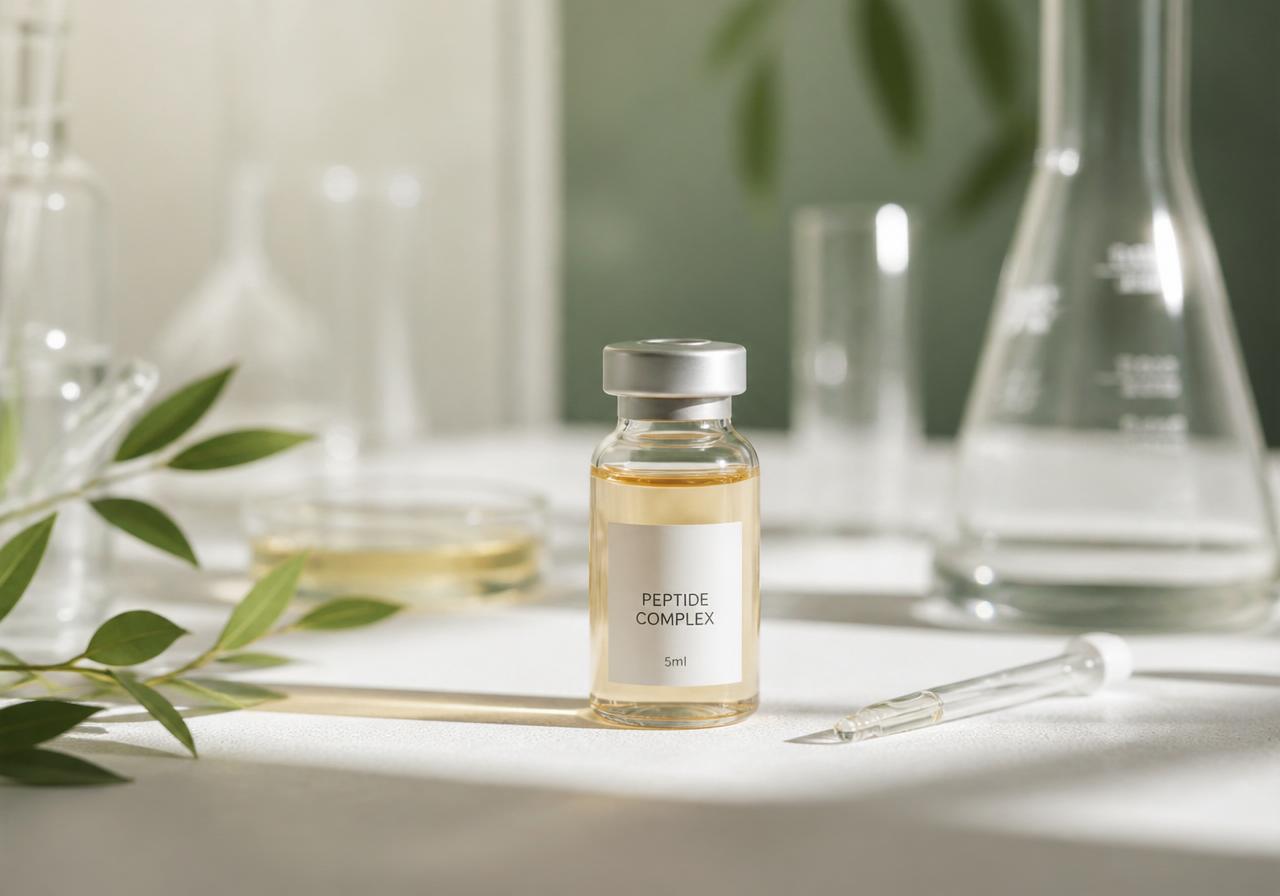
For the first time in decades, an endometriosis treatment is being developed that isn't a hormone, isn't a painkiller, and isn't a surgery. ENDO-205 — a precision peptide from California-based EndoCyclic Therapeutics — received FDA clearance to begin human trials in March 2026 (EndoCyclic Therapeutics, 2026). It's being described as 'first-in-class' and 'non-hormonal', which is genuinely unusual in a field where almost every available drug works by shutting hormones down. Because so many of my clients are sending me articles about it, this is a careful, functional-medicine read on what ENDO-205 actually is, what the science currently supports, what it doesn't, and how long realistically until it might be available.
Why this matters: the current toolkit is thin
Endometriosis affects roughly 1 in 10 girls and women of reproductive age — around 190 million worldwide — and the average diagnostic delay is still 7 to 10 years (Zondervan et al., NEJM 2020; Agarwal et al., Am J Obstet Gynecol 2019). Despite that scale, the medical playbook has barely moved in 30 years: NSAIDs, the combined pill, progestins, the Mirena coil, GnRH agonists and antagonists, and laparoscopic excision surgery (NICE NG73, 2024).
Every one of those medical options works by suppressing or manipulating hormones. They can quiet symptoms, but they do not eliminate lesions, they do not address the immune dysfunction underneath, and recurrence rates after stopping treatment — or even after surgery — remain high (Vercellini et al., Nat Rev Endocrinol 2014). For a disease that is now understood to be inflammatory and immune-mediated, not purely hormonal (Saunders & Horne, Cell 2021), a non-hormonal option is overdue.
So what is a peptide — and why is a non-hormonal one unusual?
Peptides are short chains of amino acids. Many of the body's own hormones — insulin, oxytocin, GnRH, growth hormone-releasing hormone — are peptides, which is where the (very reasonable) assumption comes from that 'peptide therapy = hormone therapy'. But peptides can also be engineered to do things that have nothing to do with the endocrine system: they can target specific cell-surface receptors, ferry a payload into a particular tissue, or trigger a localised immune response.
ENDO-205 sits firmly in that second camp. It is described by its developers as a 'precision peptide' — engineered to be selectively absorbed by endometriotic lesion tissue, and to act intracellularly within those cells to trigger natural clearance pathways, while sparing healthy surrounding tissue (EndoCyclic Therapeutics pipeline, 2026). It does not bind oestrogen receptors. It does not suppress ovulation. It does not act on the hypothalamus or pituitary. That is what 'first-in-class, non-hormonal' is referring to — and in a field defined by hormonal suppression, it really is a structural shift.
Peptides can be hormones, but they don't have to be. ENDO-205 is engineered to behave more like a guided missile to lesion tissue than a hormone signal across the whole body.
How ENDO-205 is designed to work
EndoCyclic's published mechanism describes a peptide that is selectively taken up by diseased endometriotic tissue and engages an intracellular target to activate the body's own clearance pathways — essentially flagging the lesion for removal rather than poisoning it (EndoCyclic Therapeutics, 2026; Contemporary OB/GYN, 2026). In preclinical models, the company reports elimination of endometriosis lesions and a reduction in associated inflammation, with no safety signals in GLP toxicology studies (the formal regulatory pre-clinical safety package required before any first-in-human dosing).
If that mechanism holds up in humans, it would do something none of the current drugs can: directly reduce lesion burden, without putting the body into a chemical menopause, and without disrupting the ovulatory cycle. For women who want to preserve fertility, who can't tolerate hormonal suppression, or who are tired of trading endo symptoms for side effects, that's a meaningfully different proposition.
Where it is in the research pipeline — the honest version
Here is the part the headlines tend to skip. ENDO-205 received FDA clearance of its Investigational New Drug (IND) application in March 2026 (EndoCyclic Therapeutics, 2026). That means it is allowed to begin Phase 1 trials in healthy pre-menopausal women. It has not yet been given to a single human being in a published trial. Every result so far is preclinical — cell models and animal studies.
For context, drug development typically runs through four stages after IND clearance. Phase 1 (safety and dosing, usually 1–2 years), Phase 2 (efficacy in patients with the disease, 2–3 years), Phase 3 (large randomised trials, 3–4 years), then regulatory review (around 1 year). On average, only around 10% of drugs that enter Phase 1 ever reach approval (Wong et al., Biostatistics 2019). For first-in-class molecules in complex immunological diseases, the rate is lower.
None of this is a reason to be cynical. It is a reason to be realistic. The science behind ENDO-205 is genuinely promising — it has been supported by multiple NIH awards from NICHD and in 2025 received an NIH Commercialization Readiness Pilot grant with a rare 'perfect 10' impact score (EndoCyclic Therapeutics, 2026). But promising preclinical molecules fail in humans all the time, and the women you read about being 'first in line' for ENDO-205 are, in 2026, the healthy volunteers in Phase 1.
Preclinical success and a green light to start trials are not the same as a treatment you can ask your GP for. They are the start of the long part of the road, not the end of it.
Realistically — how long until women can actually use it?
Based on the standard FDA development timeline and the typical pace for women's-health programmes, a realistic earliest-availability estimate for ENDO-205, assuming everything goes well, is around 2031–2033. That assumes Phase 1 reads out cleanly in 2027, Phase 2 in 2028–2029, Phase 3 begins in 2030, and approval and rollout follow.
If the FDA grants accelerated designations — Fast Track, Breakthrough Therapy, or Priority Review — which are plausible given the unmet need in endometriosis, that timeline can shorten by 1–2 years. If trials hit any meaningful setback (and most first-in-class drugs do), it lengthens. UK availability via NICE typically lags FDA approval by another 1–3 years.
So: not next year. Not in 2027. The honest answer for women asking 'should I wait for this?' is no — keep doing the work that helps you feel well now, and view ENDO-205 as a serious option for the next decade rather than this one.
The pros — what could genuinely be different
- Non-hormonal mechanism: no ovulation suppression, no chemical menopause, no contraceptive effect built into the treatment. Fertility is preserved in principle.
- Targets lesions directly rather than masking symptoms — the first drug designed to actually reduce disease burden rather than just manage pain.
- Tissue-selective uptake suggests a cleaner side-effect profile than systemic hormonal suppression or immune-modulating biologics.
- Addresses inflammation at the lesion, which fits the current scientific understanding of endo as an inflammatory, immune-mediated disease (Saunders & Horne, 2021).
- Could be combined with the existing toolkit (surgery, lifestyle, nutrition) rather than replacing anything — a layered approach, not an either/or.
- The same company is developing a companion imaging peptide, FemLUNA, designed to detect endometriosis non-invasively — potentially replacing the laparoscopy that currently delays diagnosis by years (EndoCyclic Therapeutics, 2026).
The cons and the open questions
- It is unproven in humans. Every claim so far rests on animal and cell-model data — historically a poor predictor of human outcomes in endometriosis (Greaves et al., Hum Reprod Update 2017).
- Cost and access are unknown. First-in-class biologic peptides typically launch at premium prices, and NHS/NICE access for women's-health drugs has historically been slow.
- Long-term safety in pregnancy, breastfeeding and across multiple cycles of use is years away from being known. Phase 1 is in healthy non-pregnant volunteers.
- Peptides are usually injectable. The route of administration for ENDO-205 has not been publicly confirmed, but this matters for real-world uptake.
- Endometriosis is heterogeneous — superficial, deep infiltrating, ovarian endometrioma, adenomyosis — and a single molecule may not work equally well across all phenotypes.
- Recurrence after stopping treatment is not yet characterised. Many endo therapies work while you take them and lose effect once you stop.
- It does not replace the foundational work — diet, gut and oestrogen-clearance support, nervous-system regulation, sleep, environmental toxin load. Lesions are one piece of a whole-body picture.
Is it safe?
The honest answer in mid-2026 is: we don't fully know yet, and anyone claiming otherwise is overstating the data. What we do know is that ENDO-205 has passed the formal pre-clinical safety package required for human trials — GLP toxicology studies with no flagged safety signals — and the FDA has reviewed and cleared the IND application, which is itself a meaningful bar (EndoCyclic Therapeutics, 2026).
What we don't yet know is how it behaves in real human bodies over weeks, months and years. That's exactly what Phase 1, then Phase 2, are designed to find out. By the time it reaches Phase 3, we'll have safety data in hundreds to thousands of women. By the time it reaches market, in tens of thousands. Today, we're at the start of that learning curve, not the end of it.
Cautious optimism is the right register. The mechanism is elegant, the regulatory bar has been cleared, and the unmet need is enormous — but human trials are where biology has the final say.
What I'd say to a client asking about it today
Watch the space, but don't put your life on hold for it. The same foundations matter now and will still matter in 2032: lowering the inflammatory load with food, supporting oestrogen clearance through the liver and gut, feeding a diverse microbiome, regulating the nervous system, reducing endocrine-disrupting chemical exposure, and building a team that includes a skilled excision surgeon if you need one (Briden, 2018; Brighten, 2019; NICE NG73, 2024).
If ENDO-205 — or a peptide like it — arrives in the next decade and works as hoped, it will land far more effectively in a body that has been cared for in the meantime. Soil first, then seeds.
References
- EndoCyclic Therapeutics. FDA Clearance of IND Application for ENDO-205, a First-in-Class Non-Hormonal Precision Peptide Therapeutic for Endometriosis. Press release, 23 March 2026. PRNewswire / BioSpace.
- EndoCyclic Therapeutics. Pipeline — ENDO-205 and FemLUNA. endocyclictherapeutics.com, accessed 2026.
- Fitch J. FDA clears ENDO-205 Investigational New Drug application for endometriosis. Contemporary OB/GYN, 23 March 2026.
- FutureFemHealth. EndoCyclic Therapeutics advances non-hormonal endometriosis drug into clinical trials. 23 March 2026.
- Zondervan KT, Becker CM, Missmer SA. Endometriosis. N Engl J Med 2020;382(13):1244–1256.
- Agarwal SK, Chapron C, Giudice LC et al. Clinical diagnosis of endometriosis: a call to action. Am J Obstet Gynecol 2019;220(4):354.e1–354.e12.
- Saunders PTK, Horne AW. Endometriosis: etiology, pathobiology, and therapeutic prospects. Cell 2021;184(11):2807–2824.
- Vercellini P, Viganò P, Somigliana E, Fedele L. Endometriosis: pathogenesis and treatment. Nat Rev Endocrinol 2014;10(5):261–275.
- Greaves E, Cousins FL, Murray A et al. A novel mouse model of endometriosis mimics human disease phenotypes. Hum Reprod Update 2017;23(5):523–544.
- Wong CH, Siah KW, Lo AW. Estimation of clinical trial success rates and related parameters. Biostatistics 2019;20(2):273–286.
- NICE NG73 — Endometriosis: diagnosis and management. National Institute for Health and Care Excellence, updated 2024.
- Briden L. Period Repair Manual. 2nd ed. Macmillan, 2018.
- Brighten J. Beyond the Pill. HarperOne, 2019.
The takeaway
ENDO-205 is the first non-hormonal, lesion-targeting peptide for endometriosis to reach human trials — a genuinely new direction in a field stuck on hormonal suppression. The mechanism is elegant and the early safety data is clean, but it is still years from being available, and only Phase 1 begins in 2026. Stay informed, stay hopeful, and keep building the inflammatory, hormonal and nervous-system foundations that will let any future treatment land better.
Monthly newsletter
Liked this? Get the monthly note.
One email a month with new research made readable, plus practical nutrition and habit notes from the Kitchen Table.