DIM and CDG: the oestrogen-clearance pair your liver has been waiting for
Why DIM alone is only half the story, how calcium-d-glucarate finishes the job, and what this pairing can do for endometriosis, adenomyosis and oestrogen-dominant symptoms — based on functional-medicine nutrition.
Written by Amy Morris, BSc (Hons) Nutritional Therapy — Functional Nutritional Therapist
DIM has become one of those supplements women hear whispered about in endo forums and adenomyosis groups — usually with the promise that it 'balances oestrogen'. The truth is more interesting, and more useful. DIM only does half the work. To actually escort used oestrogen out of the body, you almost always need its quieter partner: calcium-d-glucarate (CDG). One supports phase 1 liver detoxification, the other supports phase 2. Run them together and you have a genuinely powerful tool for oestrogen-driven conditions. Run DIM alone and you can sometimes feel worse before you feel better.
A two-minute primer on liver detoxification
Every oestrogen molecule your ovaries make — and every xenoestrogen you absorb from plastics, pesticides and personal care — eventually has to leave the body. That exit route runs through the liver in two stages. Phase 1 transforms oestrogen into intermediate metabolites (the '2-, 4- and 16-hydroxyoestrogens'). Phase 2 then conjugates those metabolites — wraps them in a water-soluble tag — so they can be packaged into bile, sent to the gut, and excreted.
Trouble begins when phase 1 runs faster than phase 2. The intermediates pile up, and some of them — particularly the 4- and 16-hydroxy forms — are more inflammatory and more proliferative than the original oestrogen they came from. From a functional-medicine standpoint, this 'bottleneck' is one of the most under-recognised drivers of endometriosis, adenomyosis, fibroids, cyclical breast pain, PMS, and oestrogen-receptor-positive concerns. The fix isn't to slow phase 1 down — it's to make sure phase 2, and the gut elimination step that follows it, can keep up.
What DIM actually does
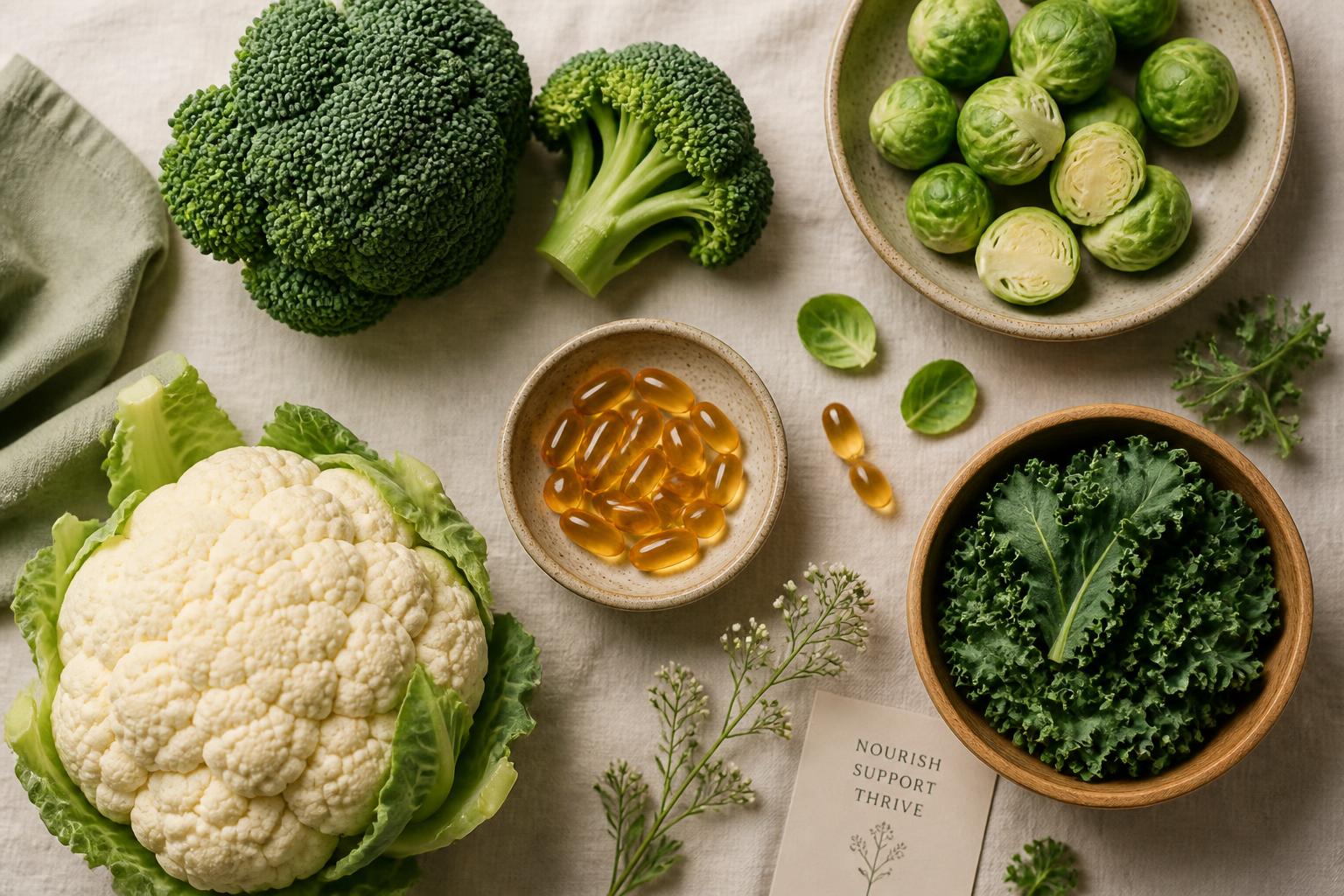
DIM (diindolylmethane) is a compound the body makes from indole-3-carbinol, which is found in cruciferous vegetables — broccoli, cauliflower, kale, rocket, cabbage, Brussels sprouts. To get a therapeutic dose from food alone you would need to eat around 1kg of raw broccoli a day, which is why a supplement is used clinically.
DIM works on phase 1. It shifts oestrogen metabolism away from the more proliferative 4- and 16-hydroxy pathways and toward the gentler 2-hydroxy pathway. In simple terms, it tells the liver to make a kinder version of oestrogen metabolites. This is exactly what you want in any oestrogen-dominant picture — heavy or painful periods, endometriosis, adenomyosis, fibroids, breast tenderness, oestrogen-driven mood symptoms.
But — and this is the part most internet articles miss — those gentler 2-hydroxy metabolites still have to leave the body. If phase 2 conjugation or gut elimination is sluggish, DIM can paradoxically increase symptoms in the first few weeks: stronger periods, more breast tenderness, headaches, irritability, body aches. That is not a sign DIM is wrong for you. It is a sign that phase 2 needs support. Which is where CDG comes in.
Why CDG is the missing half
Calcium-d-glucarate is the calcium salt of d-glucaric acid, a compound naturally present in apples, oranges, cruciferous vegetables and bean sprouts. Its job is to inhibit an enzyme in the gut called beta-glucuronidase. That enzyme — produced largely by an imbalanced microbiome — clips the conjugation tag off oestrogen that the liver has already prepared for excretion, releasing 'free' oestrogen back into circulation through the enterohepatic loop. This recirculation is one of the central drivers of oestrogen dominance, and one of the reasons gut health and hormone health are inseparable.
By lowering beta-glucuronidase activity, CDG protects the conjugated oestrogen the liver has worked hard to package, and allows it to actually leave the body in stool. Put plainly: DIM helps the liver send oestrogen down a cleaner pathway. CDG makes sure that oestrogen, once dressed for departure, actually walks out the door. Used together, they're a genuine phase 1 / phase 2 pair, and they tend to outperform either one alone.
DIM without CDG is like sending parcels to the post office without addressing them. They get prepared, then they come straight back.
Endometriosis, adenomyosis and the wider list
Endometriosis and adenomyosis are oestrogen-fed inflammatory diseases. Lesions and adenomyotic tissue produce their own local oestrogen via aromatase, and they thrive in an environment where systemic oestrogen clearance is slow. Improving phase 1 and phase 2 detoxification doesn't 'cure' either condition, but it changes the climate they live in — and clinically, that translates into lighter bleeds, less clotting, shorter and less savage flares, and gentler luteal phases.
The same metabolic logic applies to fibroids, cyclical mastalgia and fibrocystic breast changes, PMDD and PMS, oestrogen-dominant perimenopause, post-pill rebound symptoms, acne that tracks the cycle, and the 'something feels off' picture many women describe in their late 30s and 40s. It is also one of the strategies discussed for hormonally-driven cancer risk reduction, though that conversation belongs firmly with an oncology team.
- Endometriosis — supports lower oestrogenic drive on existing lesions.
- Adenomyosis — often reduces heaviness and the dragging luteal-phase pain.
- Uterine fibroids — supports slower growth signalling, particularly alongside iron repletion.
- PMS, PMDD and cyclical breast tenderness — frequently the fastest 'win' women notice.
- Perimenopausal oestrogen surges — smooths the erratic high-oestrogen days.
- Post-pill, post-Mirena and post-implant rebound symptoms.
- Cystic acne that flares premenstrually.
When to take it — all month, every other day, or luteal-only
There isn't one right protocol — there are three sensible ones, and the best one is the one your body tolerates. Functional-medicine practitioners typically choose between them based on symptom severity, sensitivity, and what other hormonal support is in play.
- All month long. Most women with ongoing oestrogen-dominance, endometriosis or adenomyosis do best on continuous daily dosing. Continuous use keeps phase 1 and phase 2 supported across every day of the cycle, including the follicular oestrogen rise.
- Every other day. If you're sensitive — meaning you notice headaches, body aches, breast tenderness or mood dips when you first start — drop to every other day for two to four weeks. This is a common, and completely normal, response. It does not mean the supplement is wrong for you; it means your detox pathways were already congested and are now clearing a backlog. Reintroduce daily dosing once symptoms settle.
- Day 14 to day 1 of the next bleed (the luteal phase). For women whose symptoms are clearly cyclical — PMS, premenstrual breast pain, luteal mood crashes, heavy bleeds — luteal-phase-only dosing is often enough. This is also a good rhythm for women who don't want continuous supplementation.
Start low, go slow, and trust transient symptoms as information rather than failure. The body is clearing something — give it a gentler pace, not a complete stop.
Where this fits with progesterone and bHRT
Bioidentical progesterone is one of the most useful tools we have in perimenopause and in oestrogen-dominant cycles — it opposes oestrogen at the receptor, calms the nervous system, and protects the uterine lining. But not every woman tolerates it, and not every woman wants it. Some feel low, foggy or bloated on oral micronised progesterone; others can't access it, can't afford ongoing private prescribing, or simply prefer a non-hormonal route first.
DIM and CDG offer a credible non-hormonal alternative for managing oestrogen excess. They don't replicate progesterone's calming or endometrial-protective effects, but they directly address the other side of the equation — how much oestrogen is hanging around to be opposed in the first place. For many women, especially in early perimenopause, getting oestrogen clearance working properly reduces symptoms enough that progesterone becomes optional rather than essential. For others, the two strategies work beautifully alongside each other.
Benefits women commonly notice
- Lighter, less clotted periods within 2–3 cycles.
- Reduced premenstrual breast tenderness, often within the first cycle.
- Calmer PMS and PMDD mood symptoms.
- Less luteal-phase bloating and water retention.
- Clearer skin, particularly around the jawline and chin.
- Improved bowel regularity (especially with CDG, via the gut-oestrogen loop).
- Reduction in cyclical migraines for some women.
- A general sense of being 'less ruled' by the second half of the cycle.
Typical side effects — and when they should resolve
Side effects from DIM and CDG are usually mild, transient, and a sign that detoxification is genuinely happening. They tend to appear in the first one to three weeks and should resolve within four to six weeks as the body adapts. If they don't, that's your signal to stop and reassess with a practitioner.
- Headaches — common in the first 1–2 weeks. Often resolves with better hydration and adequate fibre.
- Body aches or joint stiffness — typically settles within 2–3 weeks; drop to every-other-day dosing if intense.
- Initially heavier or more painful periods for the first 1–2 cycles before they lighten.
- Mild nausea if taken on an empty stomach — take with food.
- Darker-coloured urine — harmless, and a known effect of DIM metabolites.
- Transient breast tenderness or skin breakouts as oestrogen mobilises.
- Loose stools, particularly with CDG — usually settles in a week or two.
Side effects that have not eased by the 6-week mark, or that feel severe at any point, are a reason to discontinue and revisit with your practitioner — not push through.
Safety, medications and who should pause
DIM and CDG are widely available and generally well tolerated, but they are not inert. Both influence liver enzyme activity (DIM modulates CYP1A1 and CYP1A2 in particular), which means they can interact with medications metabolised by the same pathways. CDG can lower circulating levels of drugs that undergo glucuronidation, including some hormonal medications, certain pain relievers, and some antiepileptics.
If you take any prescription medication, including hormonal contraception, antidepressants, thyroid medication, statins, antiepileptics, blood thinners, or tamoxifen, speak to your GP or a qualified healthcare practitioner before starting either supplement. Avoid in pregnancy and breastfeeding unless specifically advised. Use with caution in low-oestrogen states (post-menopause without HRT, hypothalamic amenorrhoea, recovering eating-disorder pictures) — driving oestrogen clearance harder in someone whose oestrogen is already low can worsen symptoms.
These supplements are tools, not magic. They work best inside a wider picture: cruciferous vegetables daily, 30g of fibre, daily bowel movements, low alcohol, supported sleep, and a gut that isn't inflamed.
How to actually start
A typical functional-medicine starting protocol for an adult woman with oestrogen-dominant symptoms looks like this: DIM 100–200 mg once daily with food, and calcium-d-glucarate 500–1000 mg once daily with food (some practitioners split CDG into two 500 mg doses). Begin with the lower end of each, especially if you've had reactions to supplements in the past, and increase after two weeks if well-tolerated.
Layer the supplements onto food and lifestyle, not instead of them: a daily portion of cruciferous vegetables, ground flaxseed in your porridge or smoothie, plenty of water, a daily bowel movement, and a meaningful reduction in alcohol. These are the foundations that make any supplement work harder.
References
- Briden L. Period Repair Manual: Natural Treatment for Better Hormones and Better Periods. 2nd ed. Macmillan, 2018.
- Briden L. Hormone Repair Manual: Every Woman's Guide to Healthy Hormones After 40. Macmillan, 2021.
- Brighten J. Beyond the Pill. HarperOne, 2019.
- Brighten J. Is This Normal? HarperOne, 2023.
- Michnovicz JJ, Bradlow HL. Altered oestrogen metabolism and excretion in humans following consumption of indole-3-carbinol. Nutr Cancer 1991;16(1):59–66.
- Bradlow HL et al. 2-hydroxyestrone: the 'good' oestrogen. J Endocrinol 1996;150 Suppl:S259–65.
- Dalessandri KM et al. Pilot study: effect of 3,3'-diindolylmethane supplements on urinary hormone metabolites in postmenopausal women with a history of early-stage breast cancer. Nutr Cancer 2004;50(2):161–167.
- Thomson CA et al. A randomized, placebo-controlled trial of diindolylmethane for breast cancer biomarker modulation in patients taking tamoxifen. Breast Cancer Res Treat 2017;165(1):97–107.
- Walaszek Z et al. Dietary glucarate as anti-promoter of 7,12-dimethylbenz[a]anthracene-induced mammary tumorigenesis. Carcinogenesis 1986;7(9):1463–1466.
- Heerdt AS, Young CW, Borgen PI. Calcium glucarate as a chemopreventive agent in breast cancer. Isr J Med Sci 1995;31(2-3):101–105.
- Hanf V, Gonder U. Nutrition and primary prevention of breast cancer: foods, nutrients and breast cancer risk. Eur J Obstet Gynecol Reprod Biol 2005;123(2):139–149.
- Plottel CS, Blaser MJ. Microbiome and malignancy — the estrobolome. Cell Host Microbe 2011;10(4):324–335.
- Kwa M et al. The intestinal microbiome and oestrogen receptor-positive female breast cancer. J Natl Cancer Inst 2016;108(8):djw029.
- Reed GA et al. A phase I study of indole-3-carbinol in women. Cancer Epidemiol Biomarkers Prev 2005;14(8):1953–1960.
- NICE NG73 — Endometriosis: diagnosis and management. Updated 2024.
The takeaway
DIM moves oestrogen down a cleaner pathway; CDG makes sure it actually leaves the body. Use them together, start gently, listen to your cycle, and always check with your practitioner if you take medication — done well, this pair is one of the most under-used tools in oestrogen-driven women's health.
Monthly newsletter
Liked this? Get the monthly note.
One email a month with new research made readable, plus practical nutrition and habit notes from the Kitchen Table.