Methylation, methylated vitamins, and who actually needs them
Methylation is the quiet biochemical process that runs your hormones, detox pathways, mood and cardiovascular risk. But methylated vitamins are not the right choice for everyone — and for some people they can make things worse.
Written by Amy Morris, BSc (Hons) Nutritional Therapy — Functional Nutritional Therapist
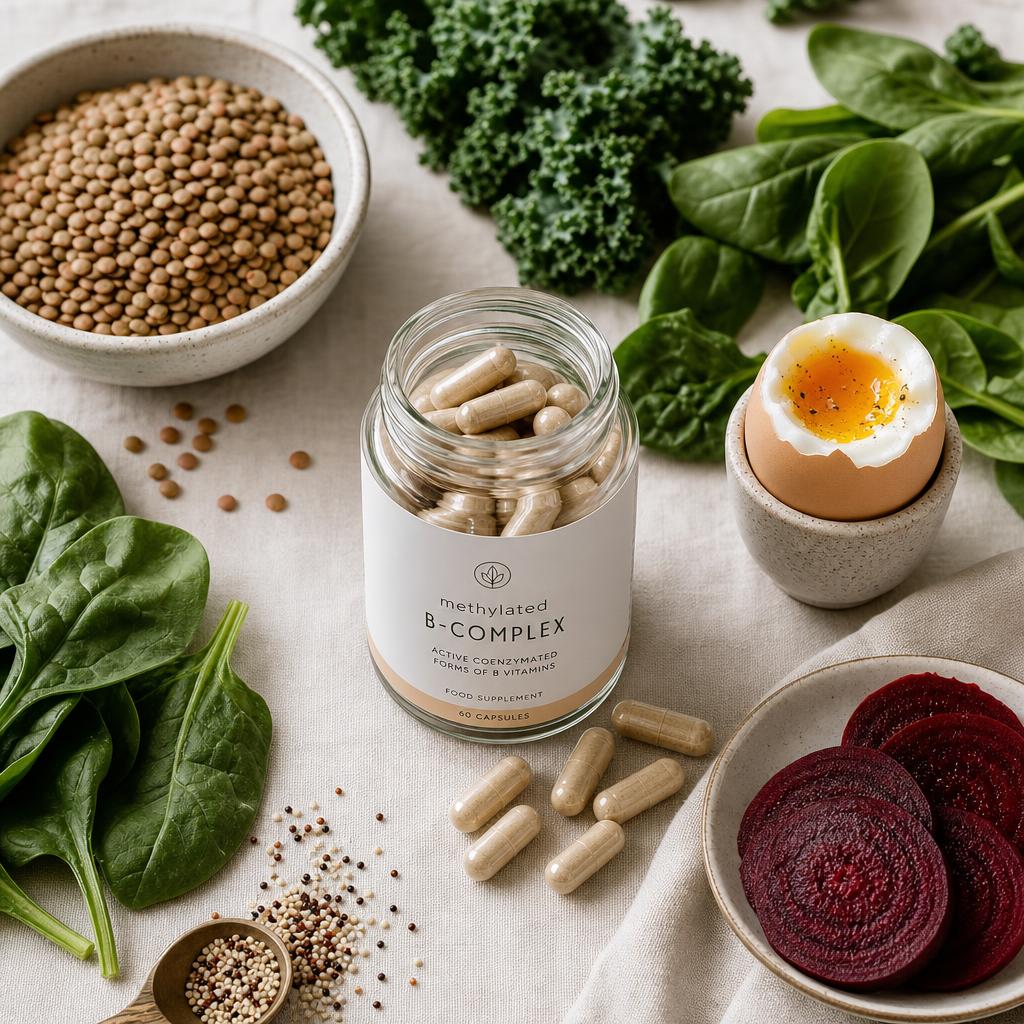
If you have spent any time in functional medicine circles, you have probably heard methylation described as everything from a fertility fix to a detox switch. It is neither magic nor marketing. Methylation is a biochemical tagging process — the transfer of a methyl group onto another molecule — that happens billions of times a day inside you. It builds neurotransmitters, repairs DNA, processes oestrogen and testosterone, supports cardiovascular health via homocysteine metabolism, and helps the liver clear hormones, histamine and some environmental toxins. When methylation is inefficient, the effects can show up as fatigue, low mood, brain fog, raised homocysteine, fertility issues, or a worsening of hormonal symptoms. But here is the part that gets missed in the supplement hype: methylated vitamins are not universally better. For some people they are genuinely helpful. For others, particularly those with slower COMT enzyme activity or a tendency to anxiety, they can feel overstimulating, agitating or simply wrong. The goal is not to methylate harder. The goal is to support the right person, at the right dose, with the right form.
What methylation actually does
Methylation is a one-carbon metabolism cycle that depends on folate, vitamin B12, vitamin B6 and riboflavin. It produces S-adenosylmethionine, or SAMe, the body’s main methyl donor. SAMe then donates methyl groups to DNA, neurotransmitters, phospholipids, hormones and proteins. The cycle also produces homocysteine, which is either recycled back into methionine using B12 and folate, or sent down the transsulfuration pathway using B6 to make glutathione, the body’s master antioxidant.
When this cycle is underpowered, homocysteine rises. Elevated homocysteine is a well-established cardiovascular risk factor and is associated with pregnancy complications, neural tube defects, cognitive decline and osteoporosis in both women and men (Crider et al., BMJ 2011; Miller, Altern Med Rev 2008). Poor methylation has also been linked to depression, anxiety, infertility, recurrent miscarriage, and a reduced capacity to clear oestrogen — which matters for endometriosis, fibroids, PMS and perimenopausal symptoms.
But methylation does not exist in isolation. It interacts with your genetics, your stress load, your gut health, your oestrogen status, your diet and your exposure to alcohol and medications that deplete B vitamins. That is why a blanket recommendation to ‘take methylfolate’ misses the point.
The methylated vitamins: what the names mean
A ‘methylated’ vitamin is one that already carries a methyl group and does not need to be converted by your enzymes before it can be used.
- Methylfolate (5-MTHF, or L-5-methyltetrahydrofolate) is the active form of folate. It bypasses the MTHFR enzyme, which converts folic acid and food folate into the usable form. This matters if you have one or two copies of the common MTHFR C677T variant, which reduces enzyme activity by 30–70% (Frosst et al., Nat Genet 1995; Crider et al., Am J Clin Nutr 2011).
- Methylcobalamin is the active form of B12. It works directly in the methionine synthase reaction that recycles homocysteine back to methionine. Some people do better on a combination of methylcobalamin and adenosylcobalamin, the mitochondrial form.
- Pyridoxal-5-phosphate (P5P) is the active form of vitamin B6. It is needed for homocysteine transsulfuration, neurotransmitter synthesis and progesterone metabolism.
- Riboflavin (B2) is not methylated, but it is a cofactor for the MTHFR enzyme itself. Some people with MTHFR variants improve homocysteine levels simply by adding riboflavin (McNulty et al., Am J Clin Nutr 2006).
Who is most likely to benefit
Methylated nutrients tend to help people who have a genuine bottleneck in the pathway. That usually shows up on testing, in symptoms, or in both. The groups I consider most often are:
- People with MTHFR C677T or A1298C variants, especially homozygous or compound heterozygous patterns, who have elevated homocysteine or symptoms that match.
- Women preparing for conception or in early pregnancy, where adequate folate — and for some, methylfolate — reduces neural tube defect and miscarriage risk (Crider et al., BMJ 2011). I always pair folate with B12 and check both levels.
- People with low B12 or pernicious anaemia risk, including vegans, older adults, and anyone on metformin or acid-suppressing medication long-term (Green & Miller, Adv Nutr 2017).
- People with depression or low mood where folate or B12 status is suboptimal. Methylfolate has been studied as an adjunct to antidepressant therapy, with the strongest evidence for people who are folate-deficient or have certain genetic variants (Miller, Altern Med Rev 2008; Papakostas et al., Am J Psychiatry 2012).
- People in perimenopause or with oestrogen-dominant conditions such as endometriosis, fibroids or heavy PMS, where methylation supports oestrogen clearance via COMT.
- Men with cardiovascular risk factors or raised homocysteine, because methylation support is not gender-specific and homocysteine is a shared risk marker.
When methylated vitamins can make you feel worse
This is the part that is often left out of the marketing. Methylated folate and B12 can produce too many methyl groups too quickly in people who do not clear them well. The COMT enzyme — catechol-O-methyltransferase — is responsible for breaking down dopamine, adrenaline and noradrenaline using methyl groups. If COMT is slower, common with the Val158Met variant, adding methyl donors can leave you feeling wired, anxious, irritable, insomniac or even manic (Lotta et al., Pharmacogenetics 1995; Harrison & Tunbridge, 2018).
I also see people with histamine intolerance or mast cell activation feel worse on high-dose methyl donors, because methylation is one of the pathways the body uses to clear histamine. Push methylation too hard without addressing the underlying histamine load, gut barrier issues or DAO enzyme function, and symptoms can flare.
Starting at too high a dose is another common mistake. A sensitive nervous system can react to 800 mcg of methylfolate or 1000 mcg of methylcobalamin when 200–400 mcg would have been plenty. I almost always start low and titrate up, especially if there is any history of anxiety, bipolar disorder, insomnia, panic or sensitivity to stimulants.
More methylation is not better methylation. The goal is a smooth cycle, not a flooded one.
Test, do not guess
Before adding methylated vitamins, I like to see where the bottleneck actually is. Useful tests include:
- Homocysteine — the simplest functional marker of methylation status. Ideally under 8–9 µmol/L, though reference ranges vary.
- Serum folate and B12 — basic but necessary. B12 should ideally be in the upper half of the reference range, not just ‘not deficient’.
- Red blood cell folate — a longer-term picture of folate status than serum folate.
- MTHFR, COMT and other relevant SNPs — useful context, but not a prescription on their own. Genes load the gun; diet, environment and stress pull the trigger.
- Organic acids or urinary methylation markers — occasionally helpful when the clinical picture does not match basic bloods.
- Full thyroid panel, iron studies and vitamin D — because fatigue and brain fog have many causes, and methylation is only one of them.
Food first: methylation nutrients on your plate
Supplements are useful, but no capsule replaces a nutrient-dense diet. The best food sources of methylation support are:
- Folate: dark leafy greens, lentils, chickpeas, asparagus, broccoli, avocado and liver.
- Vitamin B12: grass-fed meat, organ meats, eggs, full-fat organic dairy and sustainably sourced fish. Vegans need a reliable B12 supplement.
- Vitamin B6: poultry, fish, potatoes, bananas, chickpeas and sunflower seeds.
- Riboflavin: eggs, almonds, mushrooms, spinach and full-fat organic dairy.
- Choline and betaine: eggs, liver, quinoa, beets, spinach and cruciferous vegetables. Betaine is itself a methyl donor and supports the methylation cycle independently.
How I use methylated vitamins in practice
My approach is targeted and cautious. I start with food, stress and sleep foundations, then test homocysteine, B12 and folate. If someone has a clear bottleneck — elevated homocysteine, low B12, MTHFR variants with symptoms, or they are preparing for pregnancy — I will introduce a low-dose methylated B complex and watch closely.
For people who are sensitive to methyl donors, I may use a lower dose, split the dose across the day, or use forms that include hydroxocobalamin or adenosylcobalamin alongside smaller amounts of methylcobalamin. Sometimes I add magnesium and zinc, which are cofactors for many methylation enzymes, or riboflavin if MTHFR is the main issue.
I also make sure we are not using methylation support to mask a deeper problem. Low B12 can be a sign of pernicious anaemia, SIBO, low stomach acid or coeliac disease. High homocysteine can reflect hypothyroidism, kidney dysfunction, smoking or high alcohol intake. Treating the number without asking why it is high is not functional medicine.
References
- Crider KS, Bailey LB, Berry RJ. Folic acid food fortification — its history, effect, concerns, and future directions. Nutrients 2011;3(3):370–384.
- Crider KS, Devine O, Hao L, et al. Population red blood cell folate concentrations for prevention of neural tube defects. BMJ 2011;343:d7479.
- Frosst P, Blom HJ, Milos R, et al. A candidate genetic risk factor for vascular disease: a common mutation in methylenetetrahydrofolate reductase. Nat Genet 1995;10(1):111–113.
- Green R, Miller JW. Vitamin B12. Adv Nutr 2017;8(6):863–865.
- Harrison PJ, Tunbridge EM. Catechol-O-methyltransferase (COMT): a gene contributing to sex differences in brain function, and to sexual dimorphism in the predisposition to psychiatric disorders. Neuropsychopharmacology 2008;33(13):3037–3045.
- Kennedy DO. B vitamins and the brain: mechanisms, dose and efficacy — a review. Nutrients 2016;8(2):68.
- Lotta T, Vidgren J, Tilgmann C, et al. Kinetics of human soluble and membrane-bound catechol O-methyltransferase: a revised mechanism and description of the thermolabile variant of the enzyme. Biochemistry 1995;34(13):4202–4210.
- McNulty H, McKinley MC, Wilson B, et al. Impaired functioning of thermolabile methylenetetrahydrofolate reductase is dependent on riboflavin status: a potential early indicator of folate depletion. Am J Clin Nutr 2006;83(5):1195–1200.
- Miller AL. The methylation, neurotransmitter, and antioxidant connections between folate and depression. Altern Med Rev 2008;13(3):216–226.
- Papakostas GI, Shelton RC, Zajecka JM, et al. L-methylfolate as adjunctive therapy for SSRI-resistant major depressive disorder: results of two randomized, double-blind, parallel-sequential trials. Am J Psychiatry 2012;169(12):1267–1274.
- Stover PJ. Polymorphisms in 1-carbon metabolism pathway genes: a balanced approach to understanding folate and cancer risk. Annu Rev Nutr 2004;24:329–342.
The takeaway
Methylation is a real and important process, but methylated vitamins are not a universal upgrade. They are most useful for people with a genuine bottleneck — MTHFR variants, low B12, elevated homocysteine, fertility preparation, or mood issues linked to folate status — and they should be introduced at a low dose with testing. For people with slower COMT activity, histamine intolerance, anxiety or a sensitive nervous system, high-dose methyl donors can worsen sleep, mood and overstimulation. The functional medicine approach is to test, start with food, support the whole cycle including riboflavin, B6, B12 and magnesium, and adjust the dose to the person in front of you rather than the trend on social media.
Monthly newsletter
Liked this? Get the monthly note.
One email a month with new research made readable, plus practical nutrition and habit notes from the Kitchen Table.