Eat the rainbow: the most underrated principle in functional medicine
It sounds like a children's poster. It's actually a daily dose of phytochemicals your liver, gut and immune system depend on.
Written by Amy Morris, BSc (Hons) Nutritional Therapy — Functional Nutritional Therapist
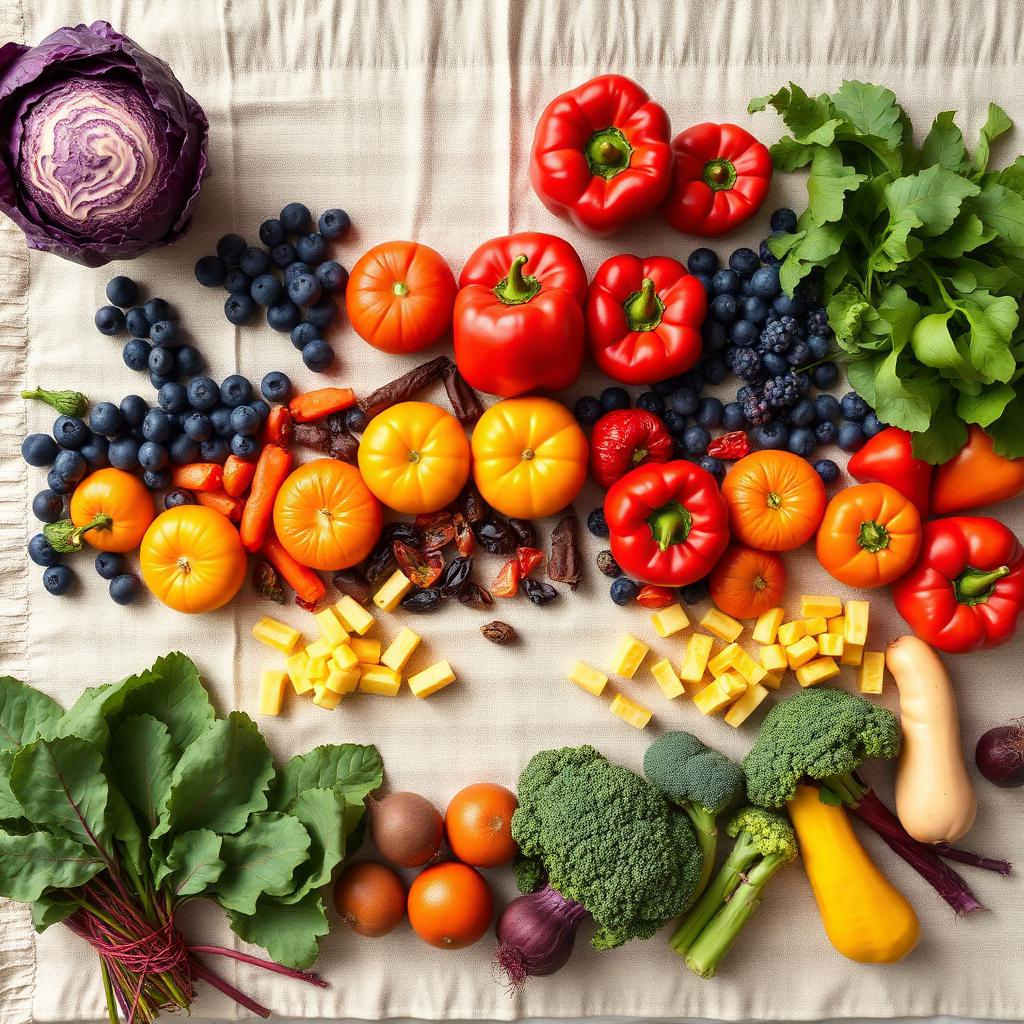
'Eat the rainbow' sounds like a children's poster, and that's exactly why most adults dismiss it. It is, in fact, one of the most evidence-rich principles in functional medicine. Every colour in a plant represents a different family of phytochemicals — polyphenols, carotenoids, anthocyanins, glucosinolates — each with distinct effects on inflammation, the gut microbiome, oestrogen metabolism and the liver's detoxification pathways. Hitting 30 different plants a week isn't a wellness flex; it's a measurable predictor of microbial diversity.
Why colour is the proxy
Colour in plants comes from secondary metabolites — compounds the plant produces to defend itself against UV, pests and pathogens. We've co-evolved to use these compounds as signalling molecules for our own immune system, gene expression and detoxification (Williamson, Mol Aspects Med 2017). Different colours = different phytochemical families = different effects. A diet built on three vegetables in rotation, no matter how nutritious those three are, can't deliver this signalling breadth.
The American Gut Project finding that changed the conversation
The American Gut Project, the largest crowd-sourced microbiome study to date, found that people eating more than 30 different plant species per week had significantly more diverse gut microbiomes than those eating fewer than 10 — and microbial diversity is one of the most robust predictors of metabolic health, immune resilience and lower all-cause mortality (McDonald et al., mSystems 2018).
Plant variety mattered more than whether the diet was vegan, paleo, or omnivorous. Diversity beat dogma.
The colour-by-colour cheat sheet
- Red (tomatoes, watermelon, red pepper, strawberries) — lycopene, anthocyanins. Cardioprotective, prostate-protective.
- Orange and yellow (carrots, sweet potato, mango, butternut) — beta-carotene, alpha-carotene, beta-cryptoxanthin. Skin, vision, immune.
- Green (broccoli, kale, rocket, watercress, Brussels sprouts) — glucosinolates → sulforaphane and indole-3-carbinol. The single most important food family for phase 1 and 2 liver detoxification and healthy oestrogen metabolism (Higdon et al., Pharmacol Res 2007).
- Blue and purple (blueberries, blackberries, red cabbage, aubergine, purple sweet potato) — anthocyanins. Strong anti-inflammatory and neuroprotective effects (Cassidy et al., Am J Clin Nutr 2016).
- White and tan (garlic, onion, leek, cauliflower, mushrooms) — allicin, quercetin, beta-glucans. Antimicrobial, immune-supportive.
The polyphenol case
Polyphenols — found in olive oil, berries, herbs, spices, dark chocolate, green tea, red wine — act as direct food for beneficial gut bacteria, particularly Akkermansia and Faecalibacterium prausnitzii, both associated with metabolic health and reduced systemic inflammation (Cardona et al., J Nutr Biochem 2013). Mediterranean dietary patterns deliver 5–10 times more polyphenols than typical Western diets, and the PREDIMED trial showed measurable cardiovascular benefit largely attributable to this phytochemical density (Estruch et al., N Engl J Med 2018).
Cruciferous vegetables earn their own paragraph
Cruciferous vegetables (broccoli, cauliflower, kale, rocket, watercress, Brussels sprouts, cabbage) contain glucoraphanin, which yields sulforaphane on chopping or chewing. Sulforaphane is one of the most potent upregulators of the Nrf2 pathway — the body's master antioxidant and detoxification switch — known to science (Houghton et al., Oxid Med Cell Longev 2016).
They also deliver indole-3-carbinol, which supports the 2-hydroxylation pathway of oestrogen metabolism — the safer of the two main routes. This matters for endometriosis, fibroids, PMS, and breast-cancer-risk reduction. Three servings a week, minimum; daily ideally. Lightly steamed preserves more of the active compounds than boiling.
How to actually hit 30 plants a week
It sounds intimidating until you start counting properly. Herbs and spices count as one each. So do nuts, seeds, beans and grains. A breakfast of oats with blueberries, ground flax, chia, walnuts and cinnamon is six plants before 8 a.m. A roasted veg tray with onion, garlic, carrot, parsnip, beetroot, rosemary and thyme is seven in one tray.
- Make every meal a 'plus three' — add three different plants to whatever was already going to be there.
- Keep a herb pot rotation on the window sill — parsley, coriander, mint, basil, chives, thyme.
- Frozen berry mix on yoghurt or oats most mornings.
- Build a 'salad of leftovers' once a week — bottom-of-fridge greens, herbs, seeds, a sauce.
- Buy one new plant a week — a vegetable, herb or pulse you've never cooked with.
Variety is the only nutrition rule that holds across every diet philosophy. If you do nothing else this year, count plant species and chase 30.
References
- Williamson G. The role of polyphenols in modern nutrition. Nutr Bull 2017;42(3):226–235.
- McDonald D et al. American Gut: an open platform for citizen science microbiome research. mSystems 2018;3(3):e00031-18.
- Higdon JV et al. Cruciferous vegetables and human cancer risk: epidemiologic evidence and mechanistic basis. Pharmacol Res 2007;55(3):224–236.
- Cassidy A et al. Higher dietary anthocyanin and flavonoid intakes are associated with anti-inflammatory effects in a population of US adults. Am J Clin Nutr 2016;102(1):172–181.
- Cardona F et al. Benefits of polyphenols on gut microbiota and implications in human health. J Nutr Biochem 2013;24(8):1415–1422.
- Estruch R et al. Primary prevention of cardiovascular disease with a Mediterranean diet supplemented with extra-virgin olive oil or nuts (PREDIMED). N Engl J Med 2018;378(25):e34.
- Houghton CA et al. Sulforaphane and other Nrf2-activating phytochemicals. Oxid Med Cell Longev 2016;2016:7857186.
The takeaway
30 plants a week, every colour represented, cruciferous vegetables daily, herbs and spices counted in. It's the most evidence-rich, lowest-controversy nutrition rule we have — and the one most adults still under-do.
Monthly newsletter
Liked this? Get the monthly note.
One email a month with new research made readable, plus practical nutrition and habit notes from the Kitchen Table.