Behaviour change is a design problem, not a willpower problem
How to stop relying on motivation and start building environments that make healthy choices the easy choice.
Written by Amy Morris, BSc (Hons) Nutritional Therapy — Functional Nutritional Therapist
After a decade of working with clients, one pattern repeats: people don't lack motivation, they lack design. They know what to do. They've read the books. They've made the spreadsheet. And then Tuesday at 6 p.m. happens, and they eat the toast. Behaviour change isn't a willpower problem because willpower runs out exactly when you need it most. It's a design problem — and the good news is that designs can be improved without becoming a different human being.
Why willpower is the wrong unit of analysis
Decades of self-regulation research treat willpower as a finite resource depleted by every conscious decision (Baumeister et al., J Pers Soc Psychol 1998). More recent work questions the depletion model but agrees on the upstream point: humans make somewhere between 200 and 35,000 decisions a day, and the more decisions you off-load to environment, the more cognitive bandwidth you have for the ones that matter (Wansink & Sobal, Environ Behav 2007). Lean on willpower and you are competing against your own evolved bias toward path-of-least-resistance behaviour. Lean on design and the path of least resistance becomes the healthy one.
Fogg's behaviour model in one sentence
BJ Fogg's model says behaviour happens when motivation, ability and a prompt converge at the same moment (B = MAP) (Fogg, 2009). You cannot reliably increase motivation. You can almost always increase ability (make it easier) and improve prompts (make the cue impossible to miss). Most failed habits aren't motivation failures — they're ability or prompt failures pretending to be motivation failures.
The four design levers
- Make it obvious — visual cues in the environment (water bottle on your desk, fruit at eye level in the fridge).
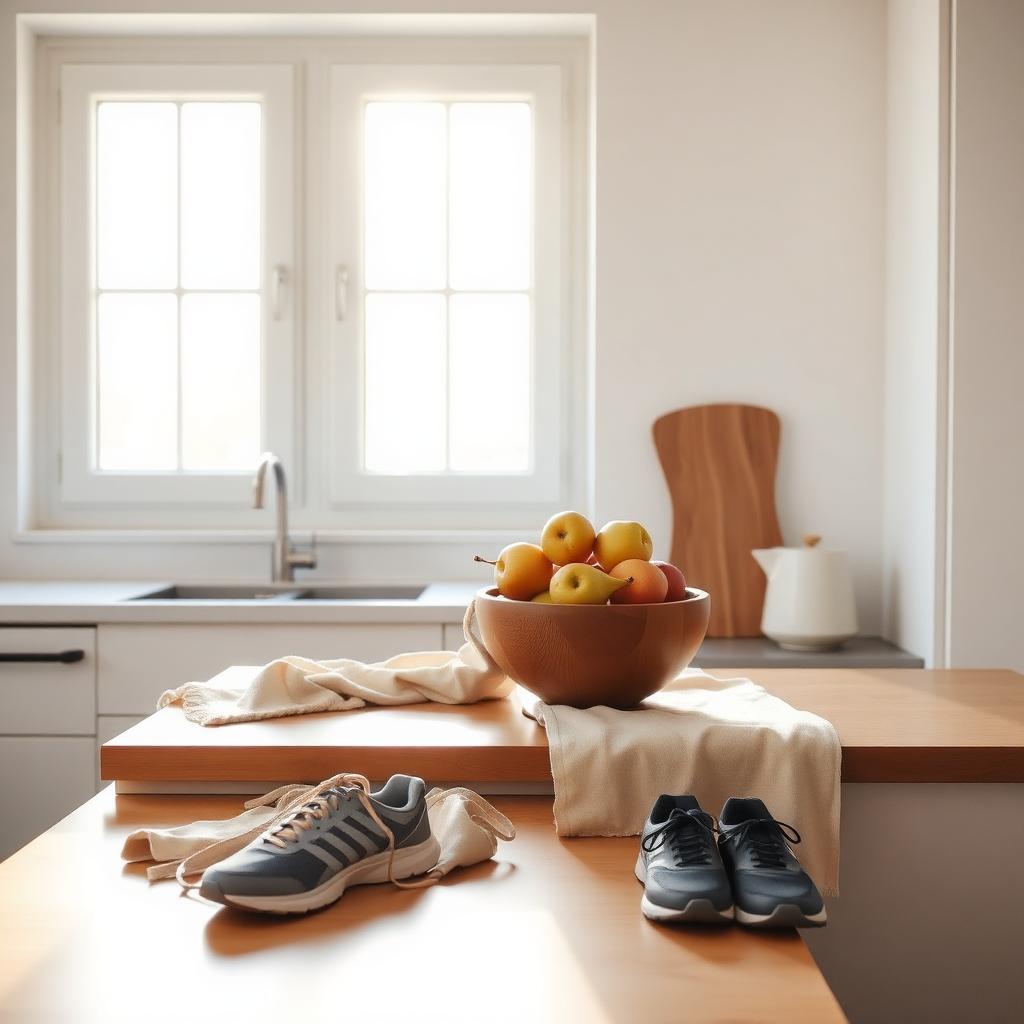
- Make it easy — reduce friction by even one step (pre-chopped vegetables, gym kit laid out the night before).
- Make it attractive — pair the new habit with something you already enjoy (podcast only on walks).
- Make it satisfying — feedback loops that close the same day (a tick on a habit tracker beats a vague 'feeling better in 6 weeks').
Choice architecture: change the kitchen, not the person
Brian Wansink's research at Cornell found that people with cereal on the counter weighed an average of 9.5 kg more than people who kept it in the pantry; people with fruit visible weighed 6 kg less. The food didn't change. The visibility did (Wansink et al., Health Educ Behav 2016).
What's on your counter is what you'll eat first when you're tired, hungry and decision-fatigued. Counter real estate is the most valuable surface in your home — give it to a fruit bowl, a herbal tea station and a glass of water, not biscuits.
Reduce friction for the right behaviour, add friction to the wrong one
Friction is the silent regulator of behaviour. Every extra step between you and a healthy meal is a small tax on the chance you'll actually eat it. Every extra step between you and a packet of biscuits is a small tax on the chance you'll eat them. Most environments are accidentally optimised the wrong way: ultra-processed food is unwrapped and ready to go, vegetables need washing, chopping, cooking.
Pre-batch protein and vegetables on a Sunday so the friction of a healthy weeknight meal drops to 5 minutes. Put the biscuit tin on a high shelf in the garage. Delete the food delivery apps from your phone — re-installing them is enough friction to interrupt a craving 70% of the time.
Identity > goals
Goals point at outcomes. Identity points at behaviour. 'I want to lose 5 kg' is a goal. 'I'm someone who walks every morning' is an identity. Identity-based change is more durable because every time you act in line with the identity, you cast another vote for it (Clear, Atomic Habits, 2018). The research on identity-based motivation backs this up: behaviour change sticks when the behaviour feels like an expression of who you are, not a sacrifice in service of a future version of you (Oyserman & Destin, Couns Psychol 2010).
Design beats discipline, especially under stress
Stress, sleep deprivation and decision fatigue all collapse our ability to make conscious health choices. This is when good design earns its keep — the kitchen architecture, the prepped food, the laid-out gym kit, the friction either side of the right and wrong choices. A well-designed environment is a system you've already won; you're just executing it.
If a habit is failing, ask 'how can I make this easier?' five times before you ask 'how can I be more disciplined?' once.
References
- Baumeister RF, Bratslavsky E, Muraven M, Tice DM. Ego depletion: is the active self a limited resource? J Pers Soc Psychol 1998;74(5):1252–1265.
- Wansink B, Sobal J. Mindless eating: the 200 daily food decisions we overlook. Environ Behav 2007;39(1):106–123.
- Fogg BJ. A behavior model for persuasive design. Persuasive '09 Proceedings, 2009.
- Wansink B, Hanks AS, Kaipainen K. Slim by design: kitchen counter correlates of obesity. Health Educ Behav 2016;43(5):552–558.
- Clear J. Atomic Habits: An Easy & Proven Way to Build Good Habits & Break Bad Ones. Avery, 2018.
- Oyserman D, Destin M. Identity-based motivation: implications for intervention. Couns Psychol 2010;38(7):1001–1043.
- Thaler RH, Sunstein CR. Nudge: Improving Decisions About Health, Wealth, and Happiness. Yale University Press, 2008.
The takeaway
Stop trying to be a more disciplined version of yourself. Re-design the spaces, schedules and defaults around the version you already are. The healthy choice has to be the easy choice, or it isn't a choice — it's a fight.
Monthly newsletter
Liked this? Get the monthly note.
One email a month with new research made readable, plus practical nutrition and habit notes from the Kitchen Table.